NDA-Gated Document Sharing: A Practical Guide for Founders and Deal Teams
By Rahul
Why NDA-Gated Document Sharing Matters
At some point in almost every business deal — a fundraising round, an M&A process, a consulting engagement, a partnership negotiation — you need to share documents that were not meant for the world. A pitch deck with your unit economics. A financial model with forward projections. An IP assignment or term sheet draft. The problem is that once a file leaves your hands through a standard email attachment or a public cloud link, you have very little say over what happens to it next.
NDA-gated document sharing solves this. It puts a legally acknowledged gate in front of your documents — a recipient must agree to your non-disclosure terms before they can see anything — and it ties that agreement to an audit trail you can actually use. This guide walks through what it is, when it makes sense, how to do it well, and what to look for in a platform.
What Is NDA-Gated Document Sharing?
What is NDA-gated document sharing? NDA-gated document sharing is a workflow in which a recipient must review and electronically accept a non-disclosure agreement before they can access a document or a set of documents. The gate sits in front of the content — not as a separate email thread or a PDF to print and scan — but as an integrated step in the access flow, with the signed record linked to the specific files the recipient then views.
The critical difference from a standalone NDA is that the agreement and the access event are captured together. You do not rely on the recipient to have signed and returned something before you send the link. The link itself enforces the sequence: sign first, then view. And because the platform records both events — the signature timestamp and the view activity — you have a coherent evidence chain if the information is ever misused.
When to Use an NDA Gate
NDA-gating is not the right tool for every document. Over-gating creates friction that reduces engagement at the wrong moment. Under-gating exposes information you have a duty to protect. Here are the situations where a gate is genuinely warranted.
Fundraising materials
A pitch deck shared at the top of a fundraising process rarely contains the information that needs protecting — it is meant to generate interest. But once a conversation advances to a data room with financial models, cap tables, customer concentration data or forward projections, the bar changes. An NDA gate at the point where you share detailed financials gives you two things: a record of who saw what, and a signed undertaking before any proprietary numbers leave your systems.
M&A and partnership due diligence
In acquisition conversations, you will be sharing contracts, employee data summaries, IP documentation and commercial agreements. Most of these carry their own confidentiality obligations to third parties. An NDA gate before the due diligence data room ensures that the counterparty's team — not just their lead — has accepted confidentiality terms before accessing sensitive records.
Consulting and agency deliverables
Strategy documents, competitive analysis, market research and financial models produced for a client often contain information the client shared in confidence. When you send the deliverable, an NDA gate protects that information from being passed to third parties — including, in some scenarios, competing advisory firms the client is also engaging.
Pre-contract commercial proposals
Detailed pricing models, technical architecture proposals and implementation plans reveal how you build and price your work. Gating these before they reach a procurement committee — where they may be shared beyond your original contact — gives you a record and a legal basis if the information surfaces at a competitor.
When Not to Use an NDA Gate
Not every sensitive document needs a formal gate. Adding friction to the wrong moments slows deals down and signals a lack of confidence. Avoid NDA gates for:
- Early-stage pitch decks shared with cold investors — the friction is not proportionate to the disclosure risk
- Marketing collateral or case studies, even if they contain customer names — a standard link with view tracking is sufficient
- Internal documents shared within a known team — use permissions, not gate flows
- Documents already covered by a signed master NDA — re-gating the same counterparty adds friction without legal value
The principle is proportionality. An NDA gate is a legal instrument as well as an access control. Use it when the disclosure risk and the legal exposure are real, not as a default wrapper for anything sensitive.
How NDA-Gating Works in Practice
A well-designed NDA-gated sharing flow has four components working together: the gate itself, the document access, the audit trail and the follow-up mechanism. Treating them as separate tools — a DocuSign for the NDA, a Google Drive link for the document, a spreadsheet for tracking — breaks the chain and creates gaps in your evidence record.
The gate step
When a recipient clicks your shared link, they see your NDA before they see any content. The agreement should be readable in the browser — not a download — and the acceptance action (a typed name, a checkbox, a signature) should be time-stamped and linked to the recipient's email address. The gate record is your evidence that they consented to the terms before viewing anything.
Staged access
Most deals involve progressive disclosure. A potential acquirer might first see a management presentation, then a financial summary, then full data room access. A good platform lets you create distinct access tiers — each potentially behind its own gate or permission level — without requiring the recipient to go through multiple separate onboarding flows. One verified identity, escalating access as the conversation matures.
Audit trail
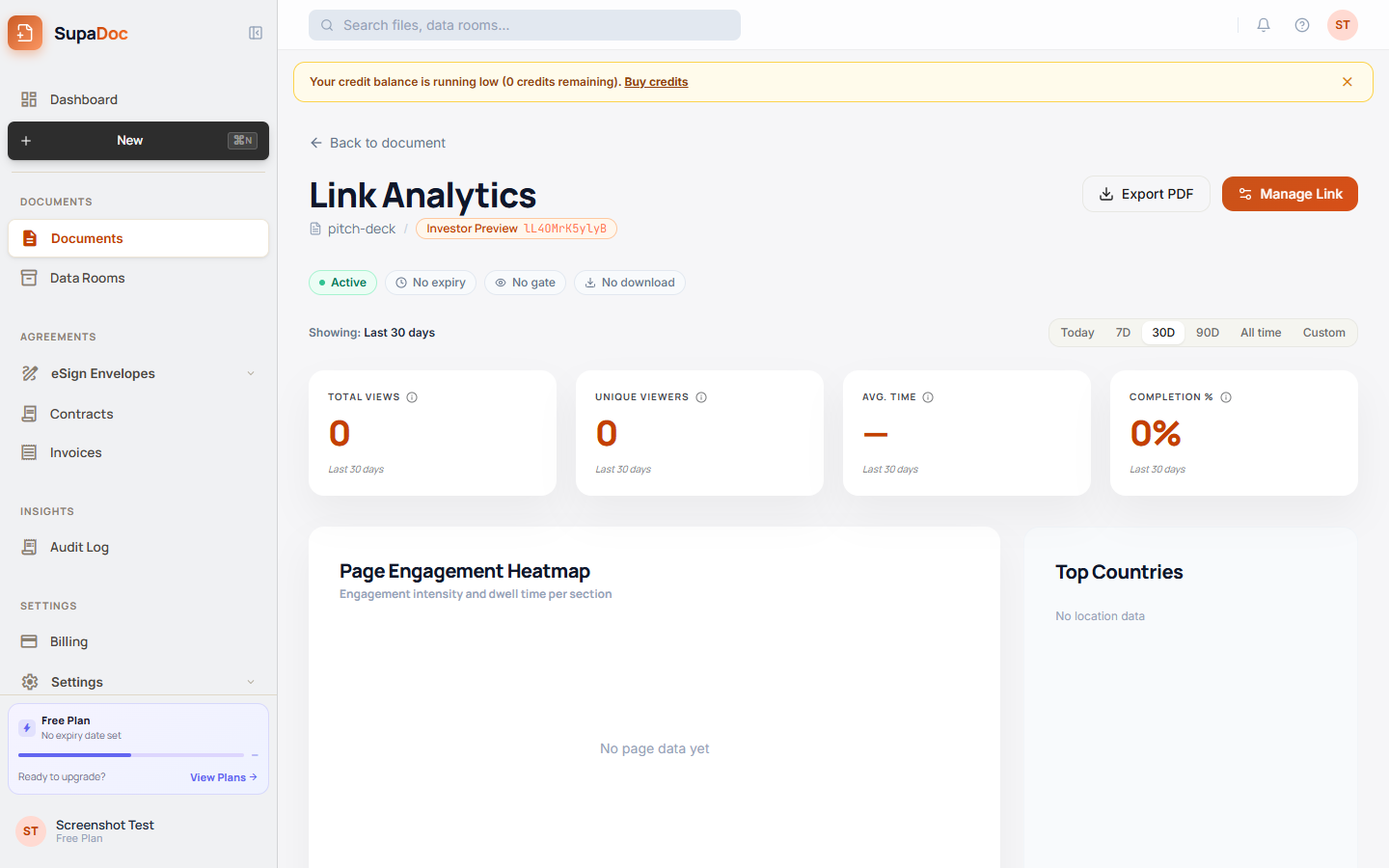
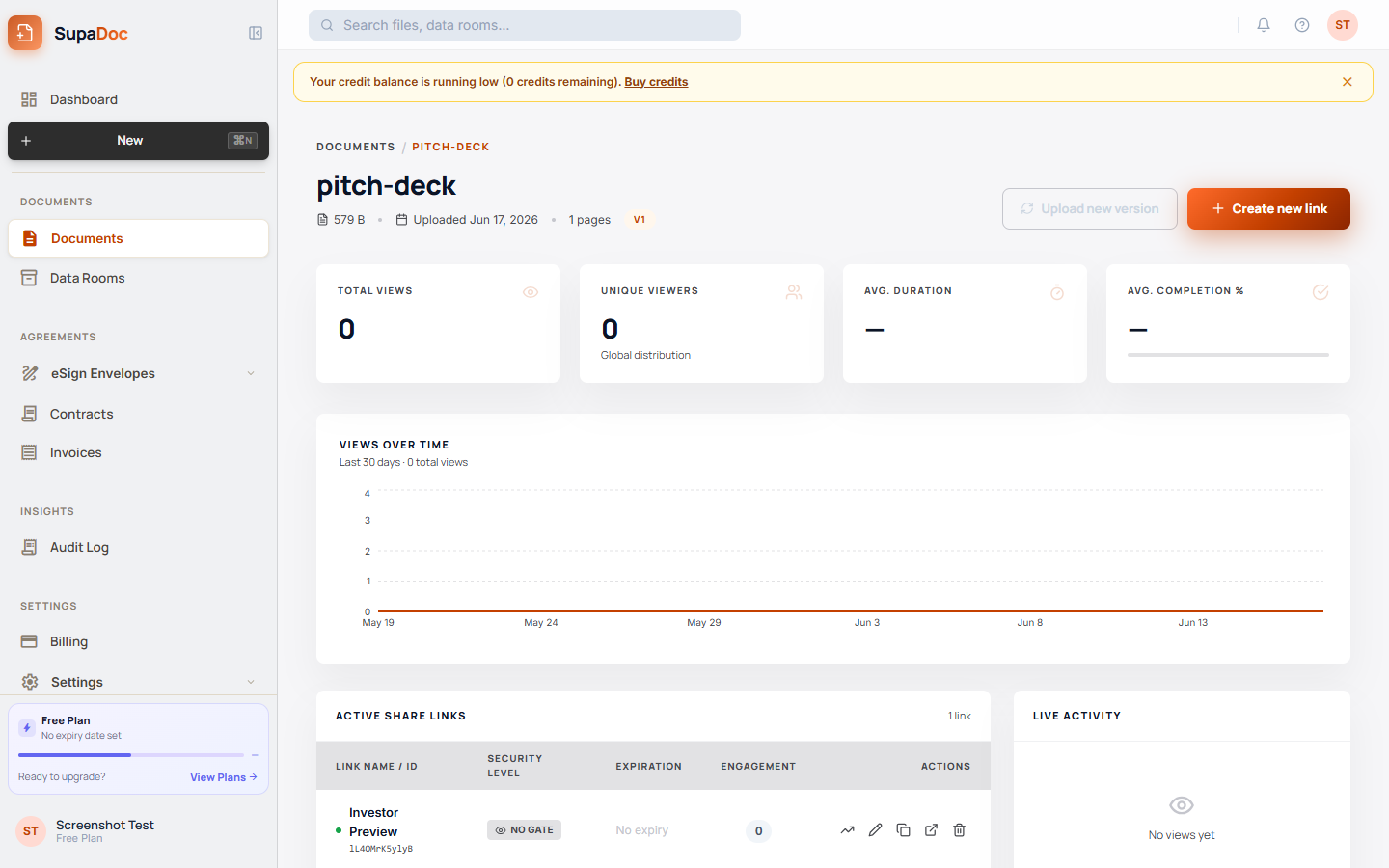
Every access event should be recorded: who opened the link, at what time, from which device and location, and for how long. Page-level view data — how many seconds were spent on the financial model, whether the cap table was opened at all — tells you where the conversation is actually focused. This is operational intelligence as much as it is legal evidence.
Link controls
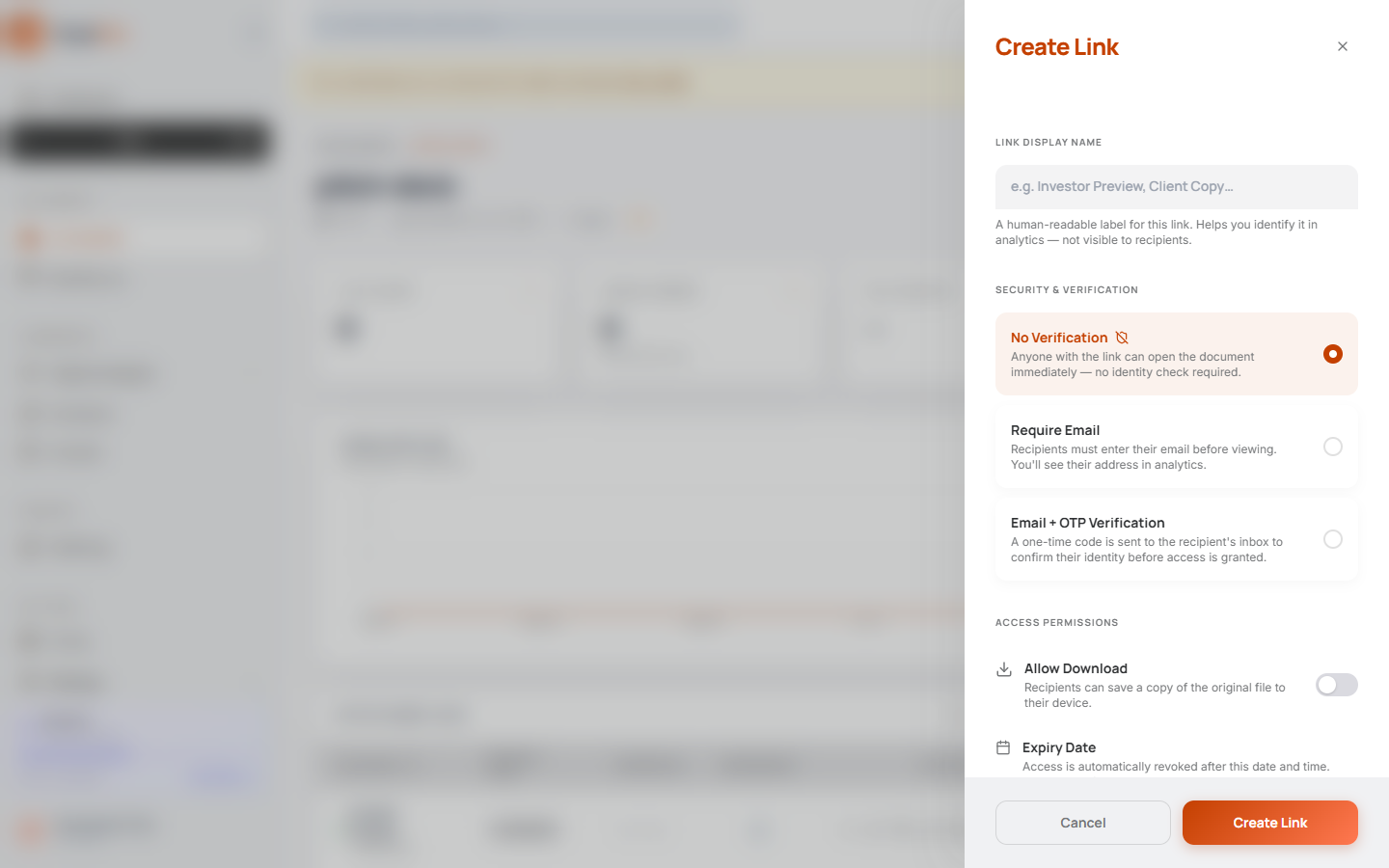
Effective NDA-gated sharing requires link-level controls: the ability to revoke access at any point, set an expiry date, restrict downloads or printing, add a visible watermark tied to the recipient's email, and disable forwarding. These controls mean the NDA is backed by technical enforcement, not just a legal promise.
What to Look for in a Platform
When choosing a tool for NDA-gated document sharing, the question is not just whether the feature exists — it is whether it creates a defensible record and fits the deal workflow your team actually runs.
| Capability | Why it matters |
|---|---|
| Integrated NDA gate (not a separate tool) | Keeps the signature and the access event in the same record |
| Page-level view analytics | Shows which sections were read, not just whether the file was opened |
| Per-recipient link controls | Lets you set different access levels for different counterparties |
| Watermarking | Deters screenshot sharing and identifies the source of any leak |
| Download and print controls | Limits what the recipient can do with the file beyond viewing |
| Link expiry and revocation | Lets you close access when the conversation ends or stalls |
| Audit export | Produces a record you can give to counsel if needed |
| VAPT compliance and data residency | Critical for documents covered by Indian data protection rules |
For Indian businesses, data residency matters. Documents shared during a fundraise or M&A process often contain personal data covered by the Digital Personal Data Protection Act 2023. Hosting your document platform on infrastructure that keeps data within India removes a compliance question from an already complex transaction.
NDA-Gated Sharing with SupaDoc
SupaDoc is built for exactly this workflow. A data room in SupaDoc gives you a structured space for deal documents, with per-link access controls, page-level analytics and the ability to gate access behind an NDA before any content is visible.
Each shareable link in SupaDoc can be configured independently: set an expiry date, require email verification, enable watermarking with the viewer's email address, restrict downloads, and revoke access with a single click. The audit trail captures every view event — by page, by duration, by recipient — and exports to PDF for legal or regulatory use.
For teams managing multiple counterparties — an investment bank running a sell-side process, a startup sharing materials with five potential lead investors — SupaDoc's data room supports separate access tiers for each recipient group, so your legal counsel sees the full document set while a secondary buyer sees only the teaser and management presentation. Start free and set up your first gated data room in under ten minutes.
The goal of an NDA gate is not to make sharing harder. It is to make the moment of disclosure traceable — so you know who saw what, when, and under which terms.
Common Mistakes When Gating Documents
Even teams that understand the value of NDA-gated sharing make avoidable errors in execution.
Using a separate NDA workflow
Sending an NDA via email for signature, then sharing the documents separately, breaks the evidence chain. If access is disputed, you need to demonstrate that the specific recipient who accepted the NDA is the same person who viewed the documents. A platform that handles both in a single flow makes that chain explicit.
Sharing the same link across multiple recipients
A single link shared broadly cannot tell you which recipient forwarded it, which one spent forty minutes on your financial model, or which one opened it from an unexpected IP address. Per-recipient links — each with its own gate and analytics — are the minimum for any deal involving more than one counterparty.
Forgetting to revoke access
A deal that falls through should close the access that went with it. Links that remain live after a conversation ends are an ongoing exposure. Build a process of revoking access when a counterparty is no longer active — most platforms make this a one-click operation if the links were created correctly.
Relying on download restrictions alone
Download prevention stops the obvious case but not a determined recipient with a screen recording tool. Watermarking — especially dynamic watermarking that embeds the viewer's email address in the document — is a more durable deterrent because it survives a screenshot. Use both controls together rather than treating one as sufficient.
A Practical Setup Checklist
Before you share your next sensitive document package, run through this checklist.
- Is the NDA and the access event captured in the same platform, not separate tools?
- Does each recipient get their own link, not a shared URL?
- Is watermarking enabled with the recipient's identifying information?
- Are download and print controls configured appropriately for this stage of the deal?
- Is there a link expiry date set, or a calendar reminder to revoke access if the conversation closes?
- Does the platform produce an audit export you can give to counsel?
- If this involves personal data, is the platform VAPT-compliant and data-resident in India?
If your current setup cannot check each of these, explore SupaDoc's data rooms — each item on this list is a standard part of the platform, not an add-on.
Frequently Asked Questions
What is NDA-gated document sharing?
NDA-gated document sharing is a method of distributing sensitive files in which a recipient must electronically accept a non-disclosure agreement before they can view any content. The acceptance is recorded and linked to subsequent access events, creating a single evidence chain for legal and compliance purposes.
Is a clickwrap NDA legally enforceable in India?
Yes. Under the Information Technology Act 2000 and the Indian Contract Act 1872, electronic signatures and clickwrap agreements constitute valid contracts in India, provided the intent to be bound is clear and the acceptance event is documented. Courts have upheld clickwrap agreements where the terms were reasonably accessible and the acceptance event is documented. Always have legal counsel review your NDA template for the specific jurisdiction and context.
What is the difference between an NDA gate and a data room?
An NDA gate is a specific access control mechanism — a step that requires agreement to confidentiality terms before content is visible. A data room is a structured environment for organising and sharing deal documents, often with multiple access tiers, analytics and permission controls. Many data rooms include NDA-gating as a feature; the two are complementary rather than alternatives.
Can I prevent recipients from taking screenshots of my documents?
No platform can technically prevent a screenshot on all devices. What you can do is make screenshots identifiable and therefore less useful as a leak mechanism. Dynamic watermarking embeds the viewer's email address or name in the document content itself, so any screenshot that surfaces externally can be traced back to the specific recipient who captured it. Combine watermarking with download restrictions to cover the most common leak vectors.
How many documents should I include in an NDA-gated share?
This depends on the deal stage. At the beginning of a fundraising or M&A conversation, share the minimum necessary to advance to the next stage — typically a management presentation and a financial summary. Reserve detailed schedules, contracts and supporting data for later stages when the counterparty is qualified. Staged access reduces unnecessary disclosure and keeps the NDA gate proportionate to what is actually being shared.
What data should an NDA-gated document audit trail capture?
A defensible audit trail should capture: recipient email address, IP address and device, the exact timestamp of NDA acceptance, each document access event with timestamp, time spent per page or section, and any download or print events. This record should be exportable in a format suitable for legal review, such as a signed PDF with a hash fingerprint.
What happens under the DPDP Act when sharing documents that contain personal data?
If the documents you are sharing contain personal data — names, financial records, employment data — the Digital Personal Data Protection Act 2023 applies to how that data is processed and to whom it is disclosed. This means your sharing platform should keep data resident in India, limit access to the minimum necessary, and maintain records of disclosure. Platforms that are VAPT-compliant and provide audit exports support these obligations.
Should I use an NDA gate for every investor meeting?
Not necessarily. Top-of-funnel investor materials — a pitch deck or a one-pager — are designed to circulate and generate interest. Gating them too early creates friction before a relationship has formed. Reserve the NDA gate for the point at which you are sharing financials, projections, or proprietary operational data — typically after an initial meeting has established genuine interest on both sides.
Can I revoke access after a deal falls through?
Yes, and you should. Any platform designed for deal document sharing should let you revoke a specific recipient's access instantly, regardless of whether the link has been forwarded or bookmarked. Revoking access at the close of a conversation limits ongoing exposure and is a standard part of deal hygiene for transactions that do not proceed.